Vaping in public places: what the UK rules say
A sign at a station entrance, a sideways look in a waiting room, a house rule pinned up beside the coffee machine. Vaping in public places produces awkward moments precisely because most people assume it works like smoking, and it does not.
British law draws a clear line between places where a statutory ban applies and places where the decision belongs to whoever controls the premises. That line does not follow the smoking line at all, and almost every misunderstanding starts there.
Vaping in public places is not covered by smokefree law
The smokefree legislation that cleared indoor spaces across the United Kingdom applies to smoking tobacco. It does not extend to vaping, because e-cigarettes do not burn tobacco and do not produce smoke in the sense the legislation defines.
That single fact explains most of the confusion. There is no blanket statutory prohibition on vaping in public places in enclosed premises the way there is for cigarettes, which is why a pub can permit it while the shop next door does not, with neither of them breaking any law.
Public health guidance issued for employers and organisations makes the same point from the other direction. It advises that vaping policies should be set separately from smoking policies rather than simply folded into them, precisely because the legal basis is different.
Vaping in public places: who actually decides
If the law is silent, someone else fills the gap, and in almost every everyday situation that someone is the occupier of the premises. Property owners, retailers, employers, licensees and transport operators all set their own rules and can enforce them as conditions of entry.
That authority is broad. A venue can prohibit vaping throughout its premises, permit it in defined areas, or say nothing at all and leave it to custom. Two neighbouring businesses can therefore apply opposite policies without either being in the wrong.
Enforcement works differently from a smoking offence too. A member of staff asking you to stop is enforcing a house rule, not recording a criminal offence, and the ultimate sanction is being asked to leave rather than a fixed penalty.
Signage matters here for a practical reason rather than a legal one. Where a venue has decided, the sign is the only way you will know, so checking the entrance before reaching for a device remains the single most useful habit.
Transport, the case most often misread
Every major British transport operator prohibits vaping across its network, and this is where people most often assume a statute exists when the mechanism is contractual. The ban sits in conditions of carriage and in railway byelaws rather than in smokefree law.
National Rail services and stations, the London Underground and the wider Transport for London network, buses and coaches all fall under that arrangement. Airports apply their own rules inside terminals, and airlines prohibit vaping in flight without exception.
Aviation adds a hardware rule worth knowing before you pack. Devices and spare lithium cells must travel in cabin baggage rather than in the hold, and airlines generally require that a device cannot be switched on accidentally in the cabin.
The practical consequence is simple. On any leg of a journey involving an operator, assume the answer is no unless a sign says otherwise, because it almost always is.
Workplaces, schools and healthcare settings
An employer has the same authority as any other occupier and may extend or restrict a policy across the premises it controls. Many organisations have written vaping into a general policy document alongside smoking, and others have deliberately treated the two separately, which is what national guidance encourages.
Shared vehicles used for work are treated as workplaces by most employers, so a company van typically falls under the same policy as an office. That catches people out more than any other category.
Schools set their own rules as a matter of policy and behaviour management, and the position is uncontroversial in practice, since sale of vaping products to under-18s is illegal across the United Kingdom. Healthcare settings vary more than any other category, with individual NHS organisations setting their own approach for buildings and grounds, so the local sign is the authority rather than any national rule.
What the 2026 legislation changed
The Tobacco and Vapes Act became law in April 2026, and it matters here even though it did not create a general ban on vaping in public places.
Its main provisions cover advertising and sponsorship of vaping and nicotine products, the free distribution of those products, and the age of sale framework. It also gives ministers powers to extend smoke-free places and to designate vape-free places by regulation, which is the mechanism to watch rather than the Act itself.
That distinction is worth holding onto. The Act creates the power to designate; what is actually designated arrives later through secondary legislation, and it can differ across England, Scotland, Wales and Northern Ireland since each administration legislates separately in this area.
A separate change already in force since June 2025 removed single use disposable vapes from sale across the United Kingdom. It has no bearing on where you can vape, but it changed what is in most people’s pockets and therefore what venues actually see.
The product rules that sit alongside the place rules
Two sets of limits define the products themselves in Britain, and they are frequently confused with the rules about places.
Refillable tanks are capped at 2 ml of capacity. Nicotine containing e-liquid is sold in bottles of no more than 10 ml, with a maximum strength of 20 mg per millilitre. Sale to anyone under 18 is prohibited throughout the United Kingdom.
Those figures describe the product, not the premises. Complying with them says nothing about whether a given café will let you use the device, which remains entirely the occupier’s call.
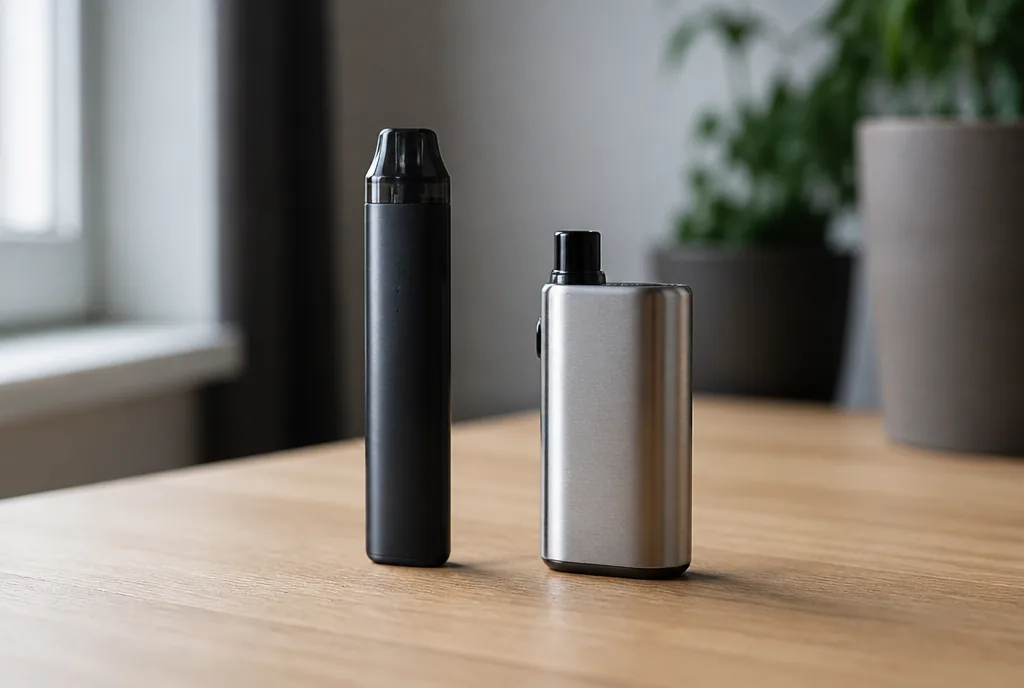
Format also has a practical bearing on how visible you are. A compact low output device produces far less visible vapour than a high wattage setup, which is why the hardware choice discussed in our guide to Vandy Vape and rebuildables is a social question as much as a technical one.
Vaping while driving
No provision of road traffic law names e-cigarettes specifically. The assessment falls back on the general requirement that a driver must remain in proper control of the vehicle at all times and have an unobstructed view of the road.
If a device in the hand interferes with control, or if vapour obscures the windscreen, prosecution for careless driving or for not being in proper control becomes possible. That judgement rests with the officer at the roadside, which is a strong argument for a compact device used when stationary.
Vehicles used for work bring in the employer’s policy on top of that, and in a shared vehicle the workplace rule usually settles the matter before the road traffic question arises.
Frequently asked questions
Is there a law against vaping in the street in the UK?
No. Outdoor public space carries no statutory prohibition on vaping. Restrictions in specific outdoor areas come from the landowner or operator, such as a station forecourt or a stadium concourse.
Can a pub or restaurant allow vaping indoors?
Yes. Because smokefree law does not cover vaping, the licensee decides. Some venues permit it, many do not, and the entrance signage is the reliable indicator.
Are disposable vapes still sold in the UK?
No. Single use disposable vapes have been illegal to sell or supply across the United Kingdom since 1 June 2025. Rechargeable, refillable devices are unaffected.
Can my employer ban vaping at work?
Yes. An employer may set a policy for the premises and vehicles it controls, including a complete prohibition, and may treat vaping differently from smoking in either direction.
What happens if I vape where a venue has banned it?
You will normally be asked to stop and, if you continue, asked to leave as a condition of entry. On the rail network, byelaws allow operators to take further action, which is why transport is the strictest category.
Vaping in public places: the short version to remember
There is no general statutory ban, and that single sentence covers most situations you will meet. Vaping in public places is decided by whoever controls the premises, which is why the answer changes from one doorway to the next without anyone being at fault.
Transport is the reliable exception, with operators prohibiting it across their networks by their own rules. Everywhere else, reading the sign at the entrance before taking a device out remains the most effective habit, and the rest of our vaping culture section covers the neighbouring questions, from hardware etiquette to what a label such as frozen e-liquid actually means.
Editorial content for adult readers only. Vaping products usually contain nicotine, a substance that causes addiction. Not for sale to under-18s in the United Kingdom. This article is not a buying recommendation and is not legal advice.