Vandy Vape: the rebuildable specialist explained
In a market where the overwhelming majority of devices run on ready made coils, a handful of manufacturers still speak to the people who build their own. Vandy Vape belongs to that group, and its catalogue is largely unreadable to anyone who has never opened an atomiser.
The initials RDA, RTA, RDTA and BF appear everywhere in its listings. They do not describe price tiers. They describe how liquid reaches the cotton, and each arrangement carries its own logic.
Vandy Vape: what the brand is known for
Founded in 2016 in Shenzhen, Vandy Vape built its name on rebuildable atomisers and on a flavour first approach. Its catalogue addresses the experienced vaper rather than the newcomer, and British stockists shelve it alongside the other rebuildable specialists rather than with mainstream pod brands.
Part of that reputation comes from its collaboration with the American reviewer Tony B, who designed the Pulse series. A manufacturer designing hardware alongside a community figure remains unusual in this sector, and it explains why the brand has such a particular foothold among people who build.
Its British visibility rests on a narrower base than a mass market brand, which matters practically. Stock tends to concentrate in specialist shops rather than in general retailers, and spares follow the same pattern.
Rebuildables: the principle and the vocabulary
A rebuildable atomiser replaces the disposable cartridge with a bare deck, on which the user installs their own resistance wire and cotton. The difference from a shop bought coil is not one of nature but of how much of the assembly you control.
The build consists of winding or fixing a heating element between two clamped posts, then threading a wick of cotton through its centre. The ends of that cotton drop into the liquid reserve and feed the element by capillary action.
The ohm value obtained depends on the metal used, its cross section and its length. It is verified on the mod’s screen before any power is applied, and that verification is what separates a controlled practice from an improvisation.
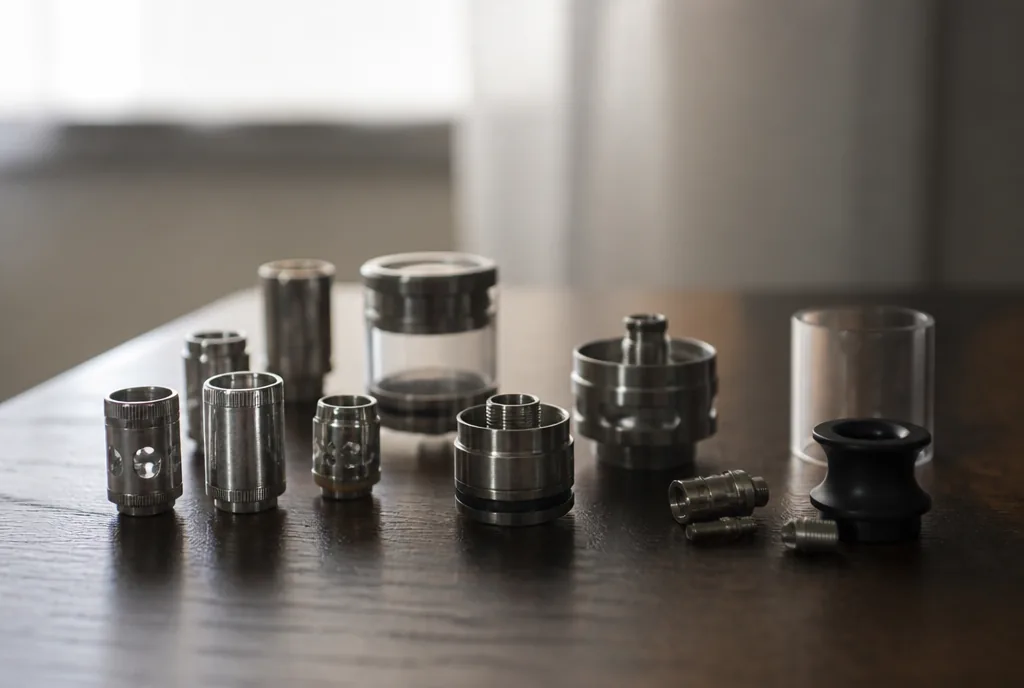
As for the initials, an RDA, or dripper, has no tank: liquid is dropped straight onto the cotton, a few drops at a time. An RTA adds a reservoir around the deck, fed through side channels. An RDTA combines the two ideas with the reserve sitting under the deck. BF, for bottom feeder, denotes a dripper fed from below by a soft bottle housed in the mod.
Squonking, the house speciality
It is on that last format that Vandy Vape made its name, and the Pulse series is what popularised the idea with European buyers.
A squonk mod houses a silicone bottle accessible through a side window. Pressing it with a finger pushes liquid up through a drilled 510 pin to the cotton in the dripper, and the surplus drains back down by gravity when you let go.
The result combines the flavour of a dripper with something closer to the convenience of a tank. The current Pulse V3 takes a single 18650 or 21700 cell with a regulated board, whereas the original Pulse BF was a mechanical mod in ABS and nylon with no regulation at all.
That distinction is the important one in the whole range. A regulated squonk mod carries the same protections as any other regulated device, and a mechanical one carries none.
Reading a cell before building anything
Because part of this catalogue is mechanical, the question of what the cell can do stops being academic. On an unregulated mod there is no board to refuse a build, no cutoff and no error message.
The method is documentary rather than numerical. Every reputable cell has a datasheet published by its actual manufacturer, and three lines on it matter: the rated capacity, the continuous discharge current the maker has tested the cell to sustain within its specified window, and the voltage limits that define where the chemistry is meant to operate.
Trace that document back to the cell maker rather than to a rewrap label or a marketplace listing, because the two frequently disagree. A cell whose datasheet you cannot find gives you nothing to reason from, and that is true whichever mod it goes into.
The build itself is then checked against that documentation, using an ohm reader, before the cell is ever inserted into a mechanical mod. Anyone not yet comfortable doing that calculation belongs on regulated hardware, where the board does the refusing.
The Vandy Vape lines that structure the catalogue
Four families are enough to make sense of the offer, with the rest being variants or limited runs.
Pulse is the squonk line. It covers the mechanical Pulse BF, the regulated Pulse BF, the V2 BF, the Pulse V3 and the all in one Pulse AIO. The interchangeable side doors on the BF mods are part of the visual signature of the series, and they are the reason so many second hand examples look nothing like each other.
Kylin is the tank line. The Kylin M RTA, the Kylin Mini II and the Kylin 3 make up the reservoir family, and the Kylin M accepts mesh strips in Kanthal A1 and in SS316L. British versions ship with glass capped at the 2 ml legal limit, which changes how often you refill compared with the same tank sold elsewhere.
Berserker is the tight draw line, given over entirely to mouth to lung inhalation with the Berserker MTL RDA and the V2, V3 and V3 Mini tanks. It targets a narrow draw and modest consumption, the opposite of the volume logic of the other families, and it is the part of the catalogue that fits British habits most naturally.
Requiem and Jackaroo close the set. The Requiem RDA at 22 mm accompanies a mechanical BF kit, and the Requiem RTA is distinguished by three interchangeable bells that alter the chamber volume. The Jackaroo Dual is a twin cell mod carrying an IP67 rating for dust and temporary immersion.
What the cotton actually does in a build
The heating element gets all the attention, but the wick is what determines the quality of the result. Its role is purely mechanical, and everything else depends on it.
The cotton has to carry liquid from the reserve to the centre of the element at a rate that matches how fast the element heats. Packed too tightly it restricts supply and dries out between puffs. Left too loose it lets excess liquid through, which drains back out of the airflow holes.
That balance explains why an identical build performs differently with different liquids. A glycerine rich recipe is more viscous, travels more slowly and wants more generous channels than a thinner base does.
It is also the clearest difference between a rebuildable and a shop bought part. The quantity and tension of the cotton are yours to set, whereas they are fixed in a factory on a prefabricated coil, as our guide to Geekvape coil series illustrates on the other side of that divide.
Who this hardware is actually for
Rebuildables demand time, an ohm reader, and a clear understanding of what a given value implies for a given cell. It is a question of method rather than talent, and the method is learnable.
A badly wired build on a mechanical mod benefits from no automatic cutoff whatsoever, unlike a regulated module. The mechanical format of certain Pulse models and of the Requiem BF kit therefore assumes you can reason about the demand a build places on a documented cell before you fire it.
For anyone starting out, a device using prefabricated coils remains the logical entry point, and the regulated mods covered in our piece on Lost Vape Centaurus show what the board is doing on your behalf. Moving to rebuildables keeps all its interest afterwards, once those electrical reference points are in place.
Frequently asked questions
What does an IP67 rating on a mod mean?
The first digit indicates complete sealing against dust, the second resistance to temporary immersion in water. It is a general industrial standard rather than a label specific to vaping.
Does a dripper get through more liquid?
Liquid placed on the cotton is not stored, so it is used quickly and replaced often. Perceived consumption is therefore higher, without the underlying efficiency being fundamentally different.
Can a rebuildable atomiser be fitted to any mod?
The 510 connection is standard, but the atomiser diameter has to be equal to or smaller than the plate to avoid overhang. A regulated mod additionally imposes the range of resistances it will accept.
What separates Kanthal A1 from SS316L?
Kanthal A1 is an iron chromium aluminium alloy with a stable resistivity. SS316L stainless steel changes resistance with temperature, a property that specific device modes rely on.
Does squonking suit use on the move?
The soft bottle stays sensitive to pressure changes and to the orientation of the device. Carrying it upright and keeping the bottle partly rather than fully filled limits unwanted liquid rising into the deck.
What the Vandy Vape catalogue says about rebuildables today
The Vandy Vape catalogue traces a particular trajectory: that of a technical segment that organised itself around precise formats instead of following the general simplification of the market. Drippers, tanks and squonk mods each solved one problem, and the naming stuck.
Learning that vocabulary pays off well beyond this one brand. It explains how every other piece of hardware works, including the simplest pod, because the same three elements are present in all of them. The rest of our vaping culture section picks up the surrounding questions for readers in the United Kingdom.
Editorial content for adult readers only. Vaping products usually contain nicotine, a substance that causes addiction. Not for sale to under-18s in the United Kingdom. This article is not a buying recommendation.